

Adaptive Learning: Key to Customization
 A smart education investor called me yesterday and asked a good question, “Can adaptive learning can be productized and sold as a service?”
Customization holds the promise of increasing learning productivity by targeting educational experiences by level, interest, and modality. Teacher judgment will increasinly be aided by smart recommendation engines that help to create individualized learning pathways.
The growth and acquisition of Carnegie Learning is a positive early signal about adaptive content. A recent research report about Dreambox use at Rocketship will boost adoption and bolster investment in adaptive content. Growth of game-based content like MangaHigh (a Learn Capital portfolio company) demonstrates the dual benefits of engagement and adaptive learning.
With active investment (impact and return seeking), it seems clear that adaptive curriculum sequences will flourish in English, math and science. The big question is how and when recommendation engines will be developed that do a great job queuing big libraries of heterogeneous content. It’s likely that improvements will be made in three approaches
1) Proprietary content: digital courseware providers including Connections, K12, McGraw, Pearson, and Time to Know are adding learning objects and improving the ability to individualize pathways to mastery.
Similarly, Wireless Generation queues open source reading content based on regular assessment results.
Proprietary (or bounded OER like FreeReading.Net and HippoCampus.org) offer curation, navigation, organization compared to mashup playlists.
2) Search: several efforts are attempting to improve search particularly across open content but they are currently hampered by a lack of common tagging standards.
The benefit of search as recommendation engine is the world becomes one big learning repository. The downside is no curation and a lot of garbage.
3) Monitoring and mining. Platforms like Edmodo (a Learn Capital portfolio company) make it easy to grab and mash up free content and drop it into an instructional stream. Behind the scenes, Edmodo is tracking the use of instructional materials and will soon have the ability to make informed recommendations.
A bit further out (i.e., 2-3 years) we’ll see next gen LMS that combine performance data and user feedback to make recommendations
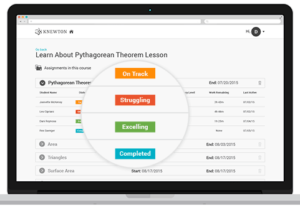
These developments bring me back to yesterday’s blog about textbooks and the benefit of curation, organization, and narration. Without a table of contents these new playlist systems will add coherence to the learning experience with standards-based gradebooks, achievement dashboards, and recognition systems (e.g., badges).
Customized learning, driven by adaptive engines and comprehensive learner profiles, will accelerate achievement and boost completion rates. Philanthropic and private equity investment is driving innovations in adaptive engines and that, with the ocean of keystroke data to come, will lead to important breakthroughs in learning and motivation sciences.



Randy W
Hi Tom --
Thanks for the post. I'd encourage the community to think about whether or not what's considered "adaptive learning" is not more accurately described as "adaptive practice". While I'm a fan of Manga High, I'd be surprised if playing the games, entirely on their own, truly teaches as there is very limited conceptual feedback provided around why I got something wrong (or right) when I do. Having access to lessons that then explain the concept is fine, but that's really still just textbook learning in an online environment, isn't it?
My two cents is "adaptive learning" better describes the provision of freedom to the student to select his/her own learning path. As we've seen with Khan Academy, students are reaching far beyond what standard curriculum would expect them to digest. Additionally, it is at least plausible that a student whose reach exceeds his grasp will be more motivated to backtrack (or adapt) to gather the skills necessary to achieve his original goal. This, I suspect, is much less likely to be the case when curriculum is wholly mandated from above.
Just this morning I posted a blog on how dating service questionnaires might be able to provide insight into a more student-centered approach (eastbayedu.wordpress.com). It builds upon the concepts you've laid out above.
Hope all is well!
Replies
Tom Vander Ark
Great comment. We'll need to develop more precise language. Dreambox is an examples of a computer selected pathway. Interesting to note while most MangaHigh games are computer directed pathways, Prodigi provides real time instruction when an error is detected.
Khan, PBL and merit badge systems allow more student-directed pathways. With the shift to digital learning, more students will have better dashboards, more choices, and be able to take more responsibility for their own learning.