

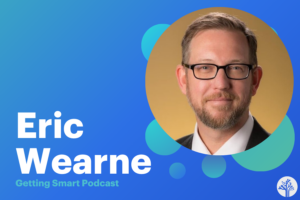
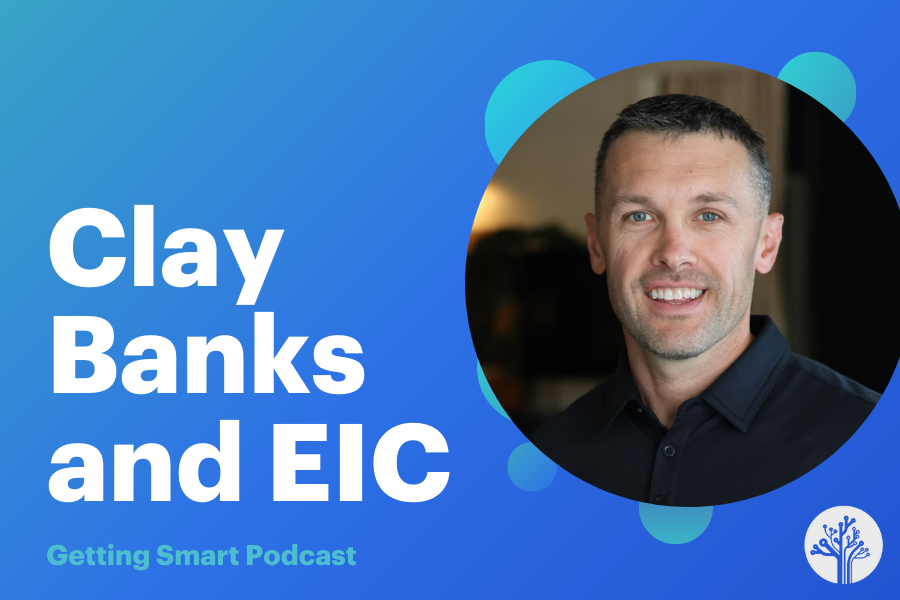
Clay Banks and EIC on Empowering Future Entrepreneurs Through Mentorship and Innovation
Key Points
-
Effective mentorship helps students prioritize, set goals, and execute on their ideas, fostering entrepreneurial and leadership skills.
-
Programs like EIC provide students with hands-on experiences, technical skills, and access to community resources, preparing them for future challenges.
Shownotes





In this episode of the Getting Smart Podcast, host Mason Pashia dives into the incredible work happening at the Entrepreneurship and Innovation Center (EIC) in Williamson County, Nashville. Joined by mentor Clay Banks and three inspiring student entrepreneurs—Abby, Samuel, and Adam—the discussion highlights how mentorship, hands-on learning, and community support are transforming education. From tackling real-world problems to developing innovative solutions like drink safety tools and AI-powered learning platforms, this conversation showcases the power of empowering students to think big and act boldly. Tune in to explore how programs like the EIC are redefining what it means to learn, lead, and create impact.
Outline
- (00:00) Introduction
- (01:47) Finding Problems Worth Solving
- (10:55) The Power of Mentorship
- (19:18) Mentoring Students vs Adults
- (31:44) Teachers as Mentors & Closing Thoughts
Introduction
Mason Pashia: You are listening to the Getting Smart podcast. I’m Mason Pashia. Today, we have a great lineup of people to talk about entrepreneurship, agency, and connecting to your community—specifically in this community. It is in Williamson County, in Nashville, Tennessee, where I went to college.
So, it’s very fun to be talking with people who are making it go there. I think back then I bumped into a bunch of people in the entrepreneurship community at the entrepreneurship center downtown. And it’s fun to be revisiting it through kind of a different lens and with some years in between.
Today, we are joined by Clay Banks, who is a mentor to some of these students and historically has built a company, sold a company, exited, and now coaches and tries to proliferate this knowledge among others. So, Clay, thanks for being here.
Clay Banks: Glad to be here. Thanks.
Mason Pashia: And then we’ve got three students who participate in the Entrepreneurship and Innovation Center in the Williamson County School System.
So, we’ve got Samuel, Adam, and Abby. Thank you all so much for being here.
Abigail Goddard: Thank you for having us.
Samuel Michael: Thank you.
Mason Pashia: Well, I’m excited to jump in. You all have been doing really amazing stuff. I’ve just kind of been hearing about it through the emails primarily, but I’m really excited to get it from your mouth this time.
We talk all the time about the idea of a problem worth solving. This is something that, like in a lot of entrepreneurship curriculum, is just about building a business plan and financial literacy, which is important but honestly misses so much of the “why” of entrepreneurship, which is really identifying a thing, delivering value based on need, and doing something that you’re kind of good at, like naturally.
Finding Problems Worth Solving
Mason Pashia: So, I would love to hear from each of you how you found a problem worth solving, and specifically how the EIC, Clay, or any of these people kind of helped you navigate that. Does anyone want to go first on this one?
Abigail Goddard: I can start.
Mason Pashia: Perfect. Thank you.
Abigail Goddard: Awesome. So, I actually came up with the problem I wanted to solve during the summer break before entering my EI one year. My first year at the EIC, I was talking to a family member about college and what I should look out for, and she told me that in her freshman year she was given a drink. She drank it without knowing that it was drugged, and then the following night she was sexually assaulted. When I heard that, obviously I wasn’t thinking about how I could make this into a profitable business. I was concerned for my family member and concerned for my future because I realized in less than two years I could be in her position.
And I am a music student at Vanderbilt, so I’m on campus at least once a week, and I wanted to see if this happened to other college students, just to see if there’s something I could do to make sure it didn’t happen to me or my friends in the future. The more college students I talked to, just casually, the more I realized how big of a problem it was.
That’s when the market research started. I realized that there could be a physical tool that helped people, one, test their drinks and, two, hold their offenders accountable if they provide that test strip to law enforcement. The EIC has really helped with understanding how to have those casual conversations with potential customers to figure out what product could solve that problem.
Mason Pashia: Abby, thanks so much for sharing. That’s a powerful story and sounds like a really awesome opportunity to kind of explore opportunity and possibility out of something that is otherwise so tragic. So, thank you for sharing. Just before I jump into Samuel, I want to ask—EIC, what is the structure of this program? You said it was your first year, so I think let’s provide some context for our listeners on kind of how that’s structured.
Abigail Goddard: Yeah, so they follow a curriculum provided by INCubatoredu, by Uncharted Learning, which basically goes through all the different parts of starting a business—problem, solution, market validation, customer segment, all of that. Pretty much the first thing they do is have you think of a bug list. So, as you’re living your daily life, write down things that kind of bug you, that you think could be improved—tools that could be better, things like that. That’s what most students use to find their problem. I guess I was lucky, but in my family member’s case, unlucky with that personal story, so I came into the EIC knowing what I was passionate about solving.
Clay Banks: Yeah, it’s a program unlike anything I’ve ever seen, especially that it’s operated within a public school system. I’ve been mentoring for, I think, five years—definitely four, if not five. And it’s evolved. I think I came in during its second year, or it was starting its second year.
They teach this curriculum that Abby was talking about, but they bring in mentors throughout the community and other people in the business community to advise the students, whether it be through mentor speed dating kind of thing, where the students will kind of round-robin the group and meet with mentors to discuss different business ideas and challenges. At the beginning, they teamed up mentors with specific students. So, there were teams, and the students would pitch themselves, and the adults would kind of pitch themselves and naturally gravitate and do a selection where I, as a mentor, would work with the same team for the whole year.
That year, I got to mentor a girl. She was right out of COVID, and her name was Grace Simmons. She had a kid’s crafting box. I think by the time she graduated school, she had done like 300 or so orders of this crafting box. Progressively, there are all kinds of pitch competitions and people from the business community—from the Chamber of Commerce—coming in and out of the facility, just watching and seeing the activity in the building. The building is really innovative. It’s got 3D printing machines, rapid prototyping machines, tons of open space, whiteboards, a pitch area where you can get on stage and practice pitching, a podcast studio, a store inside of it, and a coffee shop inside of it—all run by the students. So, it’s not just curriculum; they’re actually building and prototyping their ideas with sewing machines and all kinds of cool stuff to get their idea to market.
Mason Pashia: I think I heard that they’re planning to open a new innovation hub too, that will kind of take this to the next level by embedding a bunch of these entrepreneurial skills inside of other skillset areas like hospitality, culinary, cyber, and AI, which is amazing. We love to see entrepreneurship be a lateral cutting discipline within every other sector. That’s kind of essential.
Clay Banks: The building’s under construction now. I think they got a $13 million grant from the state—don’t quote me on that, but it’s close. I know Caterpillar and a lot of equipment companies have donated equipment to teach those skill sets for aviation, culinary, and some of the other ones that you mentioned. It’s pretty cool that we now can team up entrepreneurial teams or students with ideas and then have access to all that technology and equipment. It’s pretty cool.
Mason Pashia: Yeah, that’s amazing. So, Samuel, tell me about your journey in terms of finding a problem worth solving and really digging in.
Samuel Michael: Yeah, for sure. So, me and Adam—just for context—we work together on this project. A lot of it came, honestly, I would say, from chance and just observing the world around us. We’re both very hardworking students when it came to school, so a lot of our interactions with peers were along the lines of this class, this test, this exam—this kind of mentality of always trying to improve ourselves. We were focused a lot on school, I would say. So, when it came time for hearing from different peers and really observing the people around us, we realized that a big issue among people was that they weren’t able to learn efficiently.
We had this friend—his name was actually Philo—he struggled a lot when it came to being able to learn without spending a lot of time. A lot of times, he’d find himself studying for exams and spending hours the night before just preparing and reviewing content, only to have a few questions on the exams that went over it, and then having to review again for the final exam. So, it was almost this cycle of inefficient education for him.
On the flip side of things, we also had a very good friend and teacher for us, Ms. Drumright. She talked to us a lot about her experience as a teacher, and she told us that it was very tiresome and annoying, almost, to have to create curriculum for all these different classes. Just for more context, she teaches both high-level biomed classes and some slowed-down classes for students who maybe need to take a class over two years. Because she was dealing with this wide range of students at different levels, she noticed that being able to create curriculum and target that education toward everyone was really difficult.
Shorts Content
Seeing this, me and Adam began brainstorming how we could make this better for ourselves. For me personally—and I know Adam can relate to this too—a lot of our way of performing well in school and really understanding education was through AI. I can remember countless days of me and him sitting together. We’d have a quiz next period, take the slideshow, put it through an AI, and ask it to summarize for us. Then we’d read the summary and be able to perform better than a student who spent the last night spending all their time studying.
Seeing the contrast between our ability to access all these resources online that helped us perform well and the students who weren’t given those same resources pushed us to begin exploring other sites that are out there. Me and Adam looked into a lot of the competitors—now we call them the educational platforms—and we noticed that there wasn’t anything standard. There wasn’t anything that was really used across our school system specifically or that was created and specifically tailored for schools. A lot of these educational platforms targeted wider groups of people trying to learn a concept from scratch, but they weren’t really integrated within a classroom setting.
So, we began working, and after a couple of months, we were able to create a platform that we call Quest Learning, which basically allows us to use cognitive sciences and a lot of the research that’s out there about how to learn efficiently to make both students’ and teachers’ lives easier. To go back to your question, a lot of our identifying the problem came from observing those around us and also contrasting different types of people and seeing the patterns between how they interacted.
Mason Pashia: When you all were developing this product or this idea, how much real-time iteration were you doing with your peers? I imagine that’s kind of live because the topic was so close to all of you. Were you asking them pretty regularly, “Hey, what do you think of this?” or “What do you think of this?” How much were they involved in the design as the eventual users of this product?
Adam Rakhmanov: Yeah, for sure. I guess I can speak a little bit about this, and Samuel can add on as well. Initially, with the platform creation, there were a lot of different versions. Initially, we ran a survey across 100 students to gauge where we were at and whether this idea really needed a solution. With this survey, we found that over 90% of students were actively struggling inside the classroom. Some specific things they didn’t like were this idea of traditional-based learning where the teacher goes up, they have a slideshow, they’re teaching the students, and then the students are taking notes. A lot of the things they were complaining about were rote memorization and not understanding topics at a conceptual level.
After having these things in mind, we started developing our platform to address all of these issues. I would definitely say that with any update, we would always get feedback from our peers in the classroom. We’d say, “Okay, we just added this version. What do you think?” Or even professionals with the EIC, like Dr. Cooper—he’s one of the CTE directors. He’s actively involved in saying, “Oh, you guys are incorporating this function. I could see how this could be really useful in ensuring that students are retaining the information.” So, again, it was very multifaceted in the sense that we got real-world feedback from the students while also verifying that with the scientific and research aspects.
Mason Pashia: That’s amazing. Where are you on that product journey today? Is your school using it? Do your peers get to use the product they helped design?
Samuel Michael: Of course. Currently, I guess we’re kind of in the beta version testing. We have a minimal viable product ready—the prototype is ready to launch. But currently, what we’re working on is getting more of that feedback and user data. Because we have the product ready, we’re now wanting to incorporate it into smaller test groups to see which functions are the most applicable and which functions we should cut down on.
That’s one aspect. Another aspect we’re trying to tackle currently is the cybersecurity side—making sure all the information for the students is safe and can pass the regulations for these counties. With a lot of these counties, especially Williamson County, the barrier to entry is very high as there are a lot of guidelines like cybersecurity, where you’re storing the information for these students, whether they’re U.S.-based databases, and what ways you’re mitigating cybersecurity attacks.
Currently, we have the prototype, and we’re working on improving it while also getting it ready for production.
Mason Pashia: The lovely breadcrumb trail—once you start to solve one problem, you get to solve a bunch of other ones.
The Power of Mentorship
Mason Pashia: I want to move a little bit into this idea of mentorship because that’s something that I think the EIC really prides itself on, and a lot of the best programs we’ve seen across the country have a culture of mentorship or have a really excellent presence.
I want to start by going back through each of the three of you real quick to just hear how you think about mentorship specifically. How would you define a good mentor? Maybe give me a moment that demonstrates that. Then, Clay, I’d love to hear from you—your experience maybe summarizing some of what you’ve heard, but also just what you’ve learned from that. So, Abby, I may come back around to you if that’s all right.
Abigail Goddard: Mr. Banks mentioned Grace Simmons, who was last year’s mentee. I am this year’s, along with Adam and Samuel. Over the past year and a half, Mr. Banks has been an incredible mentor. Being able to see the bigger picture has really been what differentiates the good mentors from people who are just kind of supporters.
I know at the initial stages, I definitely did not see Spiky growing to where it is now, and even thinking beyond where I could be scaling it in college and beyond that. But he, as well as several other EIC mentors, told me from the get-go, “You need to think about IP, new products, how you can protect yourself in the future, how this can scale, and what your exit strategy is,” which is not even something I’ve wanted to think about just because I love Spiky—it’s like my brainchild. But I think especially as young founders, it’s easy to limit yourself, especially when you’re in a traditional public school system where, even if you don’t have a program like the EIC, it’s really hard to see your project going national or surpassing certain milestones.
These mentors have been able to help me grow out of that mindset but also get into the nitty-gritty details. I am a solo founder, which can be really challenging, but I’ve also had the privilege of taking on this journey of the learning curve of everything—building a website, getting the Shopify running, marketing, legal, IP, drafting NDAs, and everything—which will help me later on in the future when I decide to have a team so that I know what each role is like.
A mentor who is either hyper-specific in one field—I have a mentor for all things legal, one for brand strategy, and one for photography—has been able to help me see how all aspects of that can apply to the business.
Mason Pashia: That’s super cool. Do you feel like you have a clear idea of when you would go to a mentor versus someone else or something else? I’m trying to figure out if the mentor is typically a resource to be tapped into or if it’s actually someone that sort of comes to you and it’s a little bit harder to describe when it catalyzes something versus the alternative.
I think I’m also curious if a lot of people view a mentor as sort of a cheerleader—someone who kind of keeps you going. It sounds like to me that hasn’t been a problem for you. Spiky is exciting to you. You’re fired up. I’ve heard that from a lot of other students too, that the mentor is actually not the person that’s keeping the fire lit. They’re somebody who’s just kind of there and floats a little bit and can help keep opening the world up to you. But I’m curious—when do you think, “Oh, I should reach out to a mentor?”
Abigail Goddard: I don’t think there’s ever a wrong time to ask for mentorship. I do think, though, that it doesn’t matter how many mentors you have if you don’t have the drive to take their advice and apply it. Then the mentorship is not going to be effective.
I do have a cheerleader—that’s my dad. He’s the one who’s saying, “Get up in the morning, you got this. Go to school, go to college,” all the things. But mentors are the ones who are giving me the step-by-step action items that I can actually apply.
Mason Pashia: Yeah, that drive is super important. Awesome. Thank you. All right, Samuel, let’s go to you, and then we’ll wrap up with Adam.
Samuel Michael: Yeah, for sure. I think Abby hit the point I was going to explain with her first sentence about mentors being able to see the bigger picture. Specifically, I’ll talk about Mr. Banks because he has helped us a lot with Quest. I feel like mentors are able to see the path of your business before you’re able to see it yourself.
I can recall a conversation we had at the EIC with Mr. Banks, where it was kind of our first time for me and Adam to explain the business. We went on for, I don’t know, like 15 minutes talking about all the features, all the specific things we added, and how we had this cool thing we just designed that looked amazing. By the end of the conversation, we noticed that we’d almost lost track of what we were trying to explain.
I think what Mr. Banks told us was the biggest first step. He told us, “You guys need to be able to explain this in a way where it’s easier for others to comprehend.” At the same time, he oriented us toward our future goals. He kind of zoomed us out a little and told us, “Okay, this is the next step. You need to develop data. You need to start reaching out.”
I think what a mentor’s role is really about is looking into the larger timeline, seeing where a business is, and seeing where its next step is. A lot of times, as an entrepreneur—and more specifically probably as a tech startup entrepreneur—you’re caught up in the small, “Oh, I need to make my product like this,” or “I need to improve this in this way.” But what a mentor really does is they’re able to tell you that generally, “This is a good viable product for you now. You need to reach into marketing,” or “Your marketing’s doing well. How about trying to do this new avenue or explore this?” It’s that ability to see beyond your small scope that makes mentors like Mr. Banks so amazing.
I’ll chime in a little on the EIC because I know we talked about that. I think what makes them so valuable, and what makes the program so valuable—especially as Mr. Banks said in a public school district—is that idea of mentorship. A lot of times, students have ideas. There’s not a lack of students with ideas. There’s not a lack of problems. There’s not a lack of solutions. Sometimes, there’s a lack of programs like the EIC that connect the people with the ideas to the people who can guide those ideas.
Me and Adam could have kept working on our code, kept working on the platform, and made it perfect in our opinion, but the company would have never progressed if Mr. Banks hadn’t told us, “Now you need to move into customer discovery,” or “You need to get data from people to use it.” It’s that ability to see the bigger picture that makes mentors, in my opinion, so amazing.
Clay Banks: In November, I was preparing 24 companies at the EC for a final pitch demo day. I realized they didn’t know what good looked like, so I brought in Abby to do her pitch. I didn’t say she was 17 or give any context about her accomplishments. She delivered a flawless pitch, and the adults in the room realized, “Holy cow, this is a 17-year-old girl with AP classes, a social life, and college applications, and she’s had no excuses.”
Then they say, “Well, I can’t go build my SaaS product,” or, “I can’t go build my prototype.” And I bring in Sam and Adam, and I say, “You guys show them your pitch and what you’ve built.” They demo what they’ve built, and it’s a fully functioning prototype with a complete user interface that looks like a well-designed app. I tell the adults, “You’re saying you can’t build because you don’t have money, but here are two high school students who don’t have the money, who have social lives, who are applying for colleges, and who are doing all the other things that high school students do. They’re making no excuses.”
Here’s the thing: these students don’t have the ego yet. They’ve dropped that ego, and they’re just in this learning, reacting, and doing phase. The adults, on the other hand, have built up this part of their brain that protects them from failure or embarrassment. They’re hiding in this “want-to-be entrepreneur” state. That’s the difference between the students I get to work with and the adults. I’m trying to do more to bring the two together.
Mentoring Students vs Adults
Mason Pashia: That’s cool. We love that. If anybody’s not watching this and they’re listening, it was very cute to see all of you just light up hearing that description of what you’ve been able to achieve. The pride was evident, and it’s really incredible.
You just mentioned a word—“edupreneur”—which is pretty excellent. I don’t want that to slip by unnoticed; it’s a catchy one. But Adam, I want to ask you a question about who can be doing this. Is it just entrepreneurs who are going to be tackling this package of skills and opportunities, or do you really think that this is something that, with the right scaffolding and opportunity, everyone technically has an entrepreneur in them and can really make this happen?
Adam Rakhmanov: I think everyone has an entrepreneur in them. For some people, it’s just more developed through their past experiences or how they grew up. For example, my family owns a chain of Italian restaurants, so a majority of my childhood has been spent in that business, entrepreneurial, restaurant-management kind of environment. For me, it came a lot more naturally because of my upbringing.
But in general, I think everyone has that entrepreneur inside of them. It’s more about developing it over time—having that risk tolerance, being able to get up over and over again after failing for the 20th time on your prototype. I think everyone has it in them. It’s more about developing the appropriate skills, always being curious and inquisitive about anything you’re working on, and dropping that ego, as Clay mentioned. You have to be open to asking anyone for help, resources, or guidance to navigate the process of being an entrepreneur.
In general, yes, anyone can do it. But I guess people’s upbringings can give them an advantage or make them more conducive to an entrepreneurial mindset.
Mason Pashia: That’s great. Thanks for sharing. Abby, go ahead—build on that.
Abigail Goddard: Adding on to that, I genuinely think that anyone in any field of work can do this. Before Spiky, my sport—the thing that took up all hours of the day after school—was classical piano. Classical and competitive piano. I’ve been playing for 13 years and competing. There might seem to be very little connection between piano and entrepreneurship, but just that discipline—sitting in the discomfort of practicing every day, working at something, failing several times, performing in front of an audience, and dealing with stage fright—all of those things have translated really well into entrepreneurship. I’m sure they can translate into other fields as well.
It really is about how you can take your experience, find other people who complement that skill set or background well, and either form a team or go solo based on what you know.
Mason Pashia: I think that’s really smart. I’m a big advocate that every artist is an entrepreneur, so I totally agree with you there. We’ll have to talk more about classical piano sometime. I have one more question I want to hear from all of you today, kind of grounding this back in the listenership of this podcast.
Teachers as Mentors & Closing Thoughts
Mason Pashia: I’m curious—do you think that teachers should actually just be mentors? Are we doing that profession wrong by having it be these guides of content transfer rather than something that’s a little bit more about walking alongside students and helping them get to some other end goal that’s not just graduation or grades? Something that’s about delivering on a promise to your community or helping enact change in the real world?
Samuel Michael: I can jump in on that. For me and Adam, our project was guided by a teacher. Mr. Banks came along and helped us out a lot more recently, but the original idea itself stemmed from a teacher—Ms. Drumright. I think taking it from her perspective and what she’s done, sometimes teachers can—and it depends on how you define a teacher for yourself—either teach a subject or advance the student in a field.
If your goal as a teacher is to advance the student in a field, you have to be a mentor. A mentor is someone who guides you through your own journey. A lot of times, teachers get stuck on the idea of following a curriculum, saying, “I have the curriculum, now come along and watch how I teach this to you.” But if you reverse the roles a little, the student is on their own journey. They’ve had their past experiences, their background, their family life, and all these things. The teacher is just another step along their journey.
When a teacher approaches a student knowing that, for example, they might be interested in business or biology, they need to act as a mentor—taking every student and every person they meet at the point they’re at and guiding them to the next point. I think Mr. Banks, even though he’s not formally a teacher for us, has become a teacher through his mentorship. I’ve learned so much—and Adam has too, and I’m sure Abby has—about business and all the important concepts through his mentorship. It’s that guidance along your journey that makes the difference.
Mason Pashia: I think that’s really well said. And I would just add that we’ve been thinking a lot about this because, as artificial intelligence (AI) has entered the landscape, suddenly being the teacher who knows a lot about a subject is maybe a little less useful. That becomes something that AI agents and chatbots can kind of do. I don’t think they’re going to replace teachers, but I do think that what we define as a teacher has to shift to meet that moment.
Everybody needs a mentor. Everybody needs people to move alongside them and ultimately just care about where they get to next. Fundamentally, that’s the role, in my opinion, of a teacher-slash-mentor. Very cool. Anyone else want to throw a closing thought out there? I’ll do a little summary of some things I learned today, but feel free to jump in.
Clay Banks: I do want to touch on something that I think Williamson County will probably, in my opinion, be put on the map for. It’s a public school system, and we’ve now formed a new nonprofit 501(c)(3) charitable organization to accept family office, high-net-worth individual, and corporate donations to put into students’ businesses.
We just formed the board this summer, got the tax-exempt status set up, and have our first grant. Abby was one of the recipients who’s going to get part of that grant. Hopefully, Adam and Sam will be applying for the next round. We have a $200,000 grant coming in February, and we’re in the middle of putting $5,000 into three student businesses for the purpose of prototyping, inventory, learning, and marketing—no questions asked, no red tape, no equity. It’s just about trying to get them the resources they need to take what they’ve learned and really take it to the next level.
I’m super pumped about where this is going. Williamson County is one of the wealthiest counties in the country, and I know the amount of capital that sits here in this community. I’m just super excited about where this is going to go. But I will say this—it could not have happened if we didn’t have students like this to work with. They are the shining stars, and they’re the reason they’re on this podcast. They’re the reason they get all the notoriety.
Four or five years from now, I’m expecting millions of dollars from the community to be coming into this foundation and going into students’ businesses because of what these students are doing today.
Mason Pashia: I just want to thank all of you for being here today. I learned a ton. A couple of things that are going to stick with me from this conversation:
First, a quick plug for Incubator EDU. We’ve been fans of them and Uncharted Learning for a long time. If you haven’t checked them out, they make a lot of this easier to get started, which is half the battle at least.
Second, I loved the three definitions of what the role of a mentor is. One, prioritization, which Adam shared with us—it’s about helping people know what the right next step is. Two, helping set a big vision, which Abby shared—mentors help you get outside of the nitty-gritty details and think about where you’re going to be in five years or what your exit strategy is. And three, the importance of drive, which Abby also highlighted—you have to be able to act upon what a mentor tells you. Mentorship isn’t about the mentor doing the work for you; it’s about you taking their advice and executing on it.
Finally, I think Clay’s point about mentorship being reciprocal is so important. It’s not just about the mentor helping the mentee; it’s about both parties learning and growing together. That’s a really powerful dynamic.
Guest Bio
Clay Banks
Clay Banks is a former Fortune 500 business and life empowerment coach. After a successful eighteen-year acting career, he founded Clay Banks Productions & Studio International (CBSI) where he’s the head coach and offers ongoing on-camera acting classes. Clay is also a recurring Master Coach at SAG-AFTRA Headquarters as well as a regular guest Master Class Auditioning Coach with the American Academy of Dramatic Arts, Hollywood.
Links






0 Comments
Leave a Comment
Your email address will not be published. All fields are required.