


Times Misses the Mark–Again
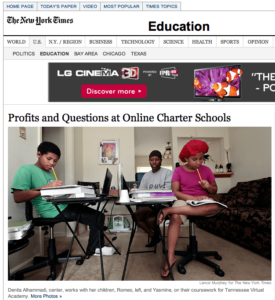
The New York Times ran a long story attacking K12, Inc. and online learning today. It is part of a series of hit pieces targeting private companies supporting innovations in learning that salaciously lift worst-case examples and present them as representative. Maybe this is what tabloids do, but we used to expect more of the Times.
They know better. Just before NBC’s Education Nation, the New York Times hosted a preemptive conference on the future of education with enough learning innovators and edupreneurs there in attendance to create a pretty clear picture of the future of personal digital learning. Their own editors and reporters have ignored the forward-leaning context created by their own convening.
The sensational barrage is against K12, the online learning provider, but it really isn’t about the company. It’s the shift from print to digital, the shift from place to service, and the emergence of the private sector as an important partner in the delivery of public education. The rise of online and blended learning is the most interesting and important story of 2011 — one that deserves investigative reporting. But instead the Times skipped the context and attacked a small segment — full time online learning — and attributed public policy problems to a private provider.
What makes this all the more ironic is that while the Times maliciously savages sector leaders like K12 and Carnegie Learning, they are out marketing their own “state of the art learning management system” called Epsilen. And they recently launched a blended learning blog. Isn’t that rich?
That brings us to Stephanie Saul who, after writing a xenophobic attack on a charter school network in July, set her sites on K12. In addition to bombastic language throughout, here are five specific problems with her ‘analysis’:
1. She portrayed parent support for choice as a shame. I’ve spent time with parent advocates from every state and visited dozens of them in their state capitals. Parent leader Rose Fernandez rightly claims that, “Parents are becoming a force to be reckoned with in public education.” But despite a twenty year struggle, most students and parents in the 99% have no educational options. K12 has done more to advance parent voice and student choice than any organization in American. Many student-serving organizations have benefited from their leadership.
2. She portrayed state policy problems as issues with K12. The fact that Colorado funds schools on beginning of the year counts is a policy problem not a vendor problem (see Take Another Look at Colorado Online Results for more). It’s fair to say that state policy makers are sorting out how to fund online and blended learning. Digital Learning Now provides sound guidance on funding digital learning.
3. I’m sorry that some teachers have not enjoyed their employment with K12, but most do. For a more balanced view, check out my interview with three K12 teachers. It concludes, “Joyce, Nancy, and Lindsay work harder than ever, but they love the flexibility, the collaboration, and the difference they make for their students.”
4. Learning online is a relatively new option. First generation options have worked better for some kids than others. It’s useful to disaggregate achievement and completion data between full time students (which is quite good) and part time students and those that sample a course and decide it’s not for them.
5. The quotes and sources are obviously biased and some are just not credible. One actually compares online learning to the mortgage meltdown–seriously? (For more, see my response to a report seeking to block online learning.)
In a sector where quality at scale is the overriding challenge, K12 has built the capacity to serve a half a million students—and more as demand grows. They invested in a content-rich curriculum. And while virtual charters got all the attention in Stephanie’s story, K12’s big push these days is building school and district partnerships.
Add a little misguided tag-team piling on from last Saturday opinion writer Gail Collins and you have a potent national attack agenda. At least Gail’s tirades are labeled opinion.
Investigative journalism is a vital part of a healthy democracy. I wish we saw more of it from the New York Times. But maybe their online learning platform, Epsilen, will pan out. Wouldn’t it be ironic if, like the Washington Post, the New York Times became primarily an online education business?
Disclosures: I am an advocate for innovations in learning with a passionate interest in expanding access to quality options for students in this country and worldwide. I am a director of the International Association for K-12 Online Learning (iNACOL). K12, Inc. is an iNACOL and Getting Smart Advocacy Partner. I support the work of Digital Learning Now and believe it is the most comprehensive and bipartisan guidance available for state policy makers.

Melissa
My HS senior is in his second year through k12. He has Adult ADHD and sleeping issues that his brick and mortar school refused to help us with. I turned to K12 1 week before his junior year - they got us registered and through the process and got us up to speed in no time flat! K12 allowed my son to retake classes for credit. By the end of his junior year, he was caught up and back on track. This year he has a 3.75 - they highest ever!! K12 is a highly flexible learning system that has been a perfect fit for my son, myself and the rest of our family. He would have flunked out of school had K12 not been there for us.
Katheryne Oliva
I just have to say that for me online school has been amazing. I always got picked on and was bullied nonstop and for nothing too. I am learning a lot actually. I love that it is so flexible and I can do work at any time and not have to be trapped in a room for 7 hours with people who dislike me or I find to be completely stupid. I love waking up late now. I always do my work. It's working for me. I get all my work done and I have 3-4 day weekends.. but even then I still work on the weekends to get ahead. It has also helped me with my OCD and germaphobia. I used to get depressed and get anxiety at school because of those 2 but not anymore. I can relax at home now.
Gail Rich Nestor
I speak as a learning coach for my two children, 10 and 8, who have attended Georgia Cyber Academy for 4 1/2 years. I have an MBA and a masters degree in health administration. Although an advanced degree is not necessary for success, I do think my input and interest enhance my kids' learning experience. We have been very satisfied with K12's curriculum and with GCA as an option. To me, GCA offers the best of all worlds. It is state-funded, so some of my tax dollars actually go back to my kids' education. They are able to move at an accelerated pace in some subjects. This keeps them challenged in the areas where they are strongest. They take the state standardized test every year, and they have the option (which I chose to do) of taking the ITBS also. GCA offers many interactive online lessons taught by certified teachers. GCA also requires 3 to 4 five-paragraph essays per student each year. These are reviewed and scored by GCA-certified teachers, providing good feedback in this important area. Scheduling is more flexible than in brick & mortar schools, and there are less distractions administratively. The online tools are amazingly fun and thorough, and they are balanced by an equally impressive set of offline textbooks, worksheets, and writing and math assignments. GCA offers many field trip opportunities, but I do also consider it important for my kids to have several other weekly activities where they interact with kids their age. We do scouts, music programs, tennis, and track. I'm sure not all learning coaches are able to stay as organized and persistent as needed, but GCA still offers a great alternative in my opinion. I am thankful to have this choice, and I feel my kids will one day be very equipped educationally to be productive members of society. They will also carry values which my husband and I think are important.
Tom Vander Ark
I think K12 was just a convenient target for an attack on virtual schools.
J.M.G.
Glad no one closed the comments to this article like they did right after the Times piece was published. One of the things that irked me most were the comments from the readers at the bottom of the article. My 11yo read a few after the article and he asked, "Mom, have they ever even spoken with anyone who uses K12?" If he can point out bias and propaganda (ironically, the unit we happened to be covering in one of his K12 courses), why can't an adult? It was sad to see a complete misrepresentation of the program, the parents and students. He also drew the conclusion that most readers that commented assumed parents left their child at home all day, alone and to their own devices. "What kind of parents do they think we have, here?" Great question. Many K12 parents set the bar for being involved (an attribute that researchers say contribute to the overall success of students). Gail's tirade left much unexplained, enough for the uninformed to draw illogical conclusions and strengthen the campaign against anything outside of the box in terms of education. It was even turned it into a money/funding issue, questioning the legitimacy of the program because they assumed the budget went into the pockets of millionaires. My kid also pointed out the plethora of resources we have provided for us - so we SEE the money. What we don't see are broken/stolen/otherwise unacceptable materials that he had to make use of when he attended a traditional public school. All in all, it's a robust and dynamic program. Perhaps once the Times launches their own academic program (isn't that something?), they will retract and become advocates of online ed.
Aimee
My children have been in California Virtual Academy (CAVA) for a year this January. We pulled out of brick and mortar school because of the way the schools are ran. My 8th grader was counted absent for 21 days when in reality she was only absent for 3 (3 days x 7 classes = 21). My son is high functioning autistic and was bullied badly. We are a military family and the school district is the best in Northern California, but they were about 1-2 yrs behind. Now my daughter is working at a 9th grade level reading at a 12th grade level. My son had figured out the easiest and best way for him to learn. The district was not allowing him freedom to learn the way he is able to learn and in 1st grade was reading at a preschool level. Now he is learning at a 3rd grade level but is in 2nd grade. He is HAPPY. My 8th grader is making all A's and is ahead in her curriculum. I watch my friend's children, all in public school. Have to go through homework with them. My daughter is doing better than my friend's daughter in math, who is in 9th grade. My 2nd grader is doing higher math and reading at the same level as my friend's 3rd grader. I never ever thought my son would enjoy math, and seeing him read at a 3rd grade level a year after entering k12 is amazing. Especially when he was only at a kindergarten reading level this time last year. K12 is an amazing program. It is not just for those who are failing out of traditional brick and mortar schools. (My 8th grader has made all A's since she was in kindergarten.) K12 is a wonderful choice for homeschooling. The families are held to a higher standard and held accountable for their education. The teachers are certified teachers. The students have several options to show they are within national education standards including mandatory state testing and other online testing. They receive one on one attention by being at home and are able to have a fully enriched education by including music and art, classes that are being removed from traditional schools. The teachers are available daily for anything. I am amazed by the program, and how happy my children have become. My family is much more relaxed and I am watching my childrens' minds grow daily.
Rosa Martin
My children have had the privilege of attending a blended K12 school since Kindergarten. It is more work than I had imagined and far more rewarding than I had hoped. Thank you, K12, for ignoring legislation and bad press. Thank you, K12, for providing my family with curriculum that I would have to pay $15k plus for in my city's private schools. $15k for each child, mind you.
K12 has let me know how it feels to have a huge company fighting for my child's future.
Warren Boyd
My son started K12 this year.He is a very smart child.The school he went to could not accomidate him.
The learning pace was to slow for him therefore he was bored.He did not want to go to school for that reason.Now he can work at his pace.He loves it.He is making A's now and is ahead of his schedule.My wife and I are very thankful for K12!
Warren
Cathy Bryan
We are in our 9th year with OHVA, a K12 virtual academy, and my daughter will graduate as one of the kids who attended for all 13 years of her schooling (K-12). We initially chose e-schooling because of a learning-style issue for my son, but it's become a life-style for us. We love the flexibility that e-schooling allows. My mom is a retired teacher from a district with an excellent rating here in Ohio, and she said the K12 curriculum is the best she's ever seen. School doesn't take 10 hours/day, so my kids are involved in other activities such as 4-H, Boy Scouts, competitive dance, and volunteering. My son is a 17 yr old Eagle Scout and my daughter is does historical re-enactments along side adults with DatyonHistory.org. We travel off-season (which costs less) and my kids have visited many of the historical sites other kids just read about in their history books. What an incredible opportunity technology has created for us!
Alex
This guy in Austin seems to be on the right track - new facilities and new methods of teaching. Too many times everything surrounding conversations about education are arguments. This guy just wants to fix it:
http://www.youtube.com/watch?v=xj3Zc-SF0YE
Amber Kendall
My Daughter made it through kindergarten in public school, she not only did not know how to read according to them but failed art and came home discussing racism at 5 yrs old, I pulled her and went through an alternative school which supported the k-12 program. Now She is in second grade and tests off the charts! I have never made a better decision for her. She not only is getting a wonderful education but also is less cranky, and more involved with violin lessons, soccer, jr. grange and more! Thank you k-12 for what you have given my family, the right to a solid education without the torture that our public schools have become!
Jody Johnson
It's nice to have options! I have a wonderful sixteen year old son who is very creative & intelligent. He is bored to death in school. We have so much stimulation in the world today. We ask our kids to sit in a chair for hours, non stimulated. Our local public school system is on the cutting edge. But, it's not changing fast enough for him. K12 allows him time to do other things. He already is a budding entrepreneur and has a UTube sight with 5,000 hits.We are grateful for this outside of the box option.
Jen L.
My son attends Texas Virtual Academy at Southwest - only he couldn't start on time this year. He had open heart surgery on August 23rd, the first day of school.
His surgery was 8 hours, and he was in the hospital three weeks. The surgeons wanted us to "keep him out of school" for another two months after that - when we explained about K12, that we would be able to pace him, that it would not be physically taxing, they gave us approval to start as soon as he was ready. He chose to return the week he was out of the hospital.
His teacher was aware of everything, helped us get him back in a groove, and instead of missing the three weeks of school he was able to start from the first day of school 3 weeks late - without K12, I have no doubt his 8th Grade Year would have potentially been down the drain. Because of K12, he was able to ease back into his normal life at his own pace, with the support of his parents and the school - and most especially his teacher.
I wish they would profile some of us for a change.
Maple_Fan
There is almost NO flexibility in brick-and-mortar middle schools for students who love to learn but have delayed fine motor, gross motor, and organizational skills.Even his IEP was not honored, and he was termed "lazy." With the scheduling flexibility of OHVA which allows him to work longer on classes which take longer and move more quickly through content which comes easy for him, he has regained his love of learning and is reading every day because he WANTS to. He is progress monitored against the current ODE 7th Grade Standards as well as the OAA goals. He has teachers who WANT to hear from me as the parent, and he has an Intervention Specialist who knows his educational strengths and weaknesses. We have had bumps along the way, of course, but overall this school year has been FANTASTIC compared to the hell of 6th grade in a traditional public middle school.
Lindsay Woods, VAVA
Thank you for defending online schooling options! As a teacher for Virginia Virtual Academy it has been difficult to read the recent articles and be so grossly misrepresented.
vickie chaffin
This is our fourth year with OHVA. As a former reading specialist, I can't say enough good things about this experience. Like others, my son was bored at a brick and mortar school. He was looking for reasons not to go. Now he will finish his 7th grade classes this Jan. and can start on 8th grade. He reads at a 12th grade level and both math and reading scores on state testing is off the charts. I really don't think we would have had this much success had he stayed in traditional school. He has read several classics (White Fang, Sherlock Holmes, Tom Sawyer) and Shakespeare as part of the curriculum. When my father was battling cancer and passed away all we had to do was let our teacher know. Not only was it not a problem, she made sure to check on my son and his grandpa. This gave all of us the flexibility to cope with this trying circumstance. No one ever demanded he not miss many days or get right back to it the way my nephew's school did.
This type of education demands commitment and hard work from both the student and parent, but for us it's worth it. I wonder if some of the parental naysayers are like the ones I've met. They found out how much of their time they needed to devote to this. (my house isn't always as clean as I wish, I can't just run out to shop when I want) When they didn't give 100%, success did not come.
Jennifer Hooper
I'm a working single mother of 4 daughters who attend VAVA (Virginia Virtual Academy). They are in 7th, 6th, 3rd and Kindergarten. My youngest turned 5 on the school cut off date so I was worried that she'd be behind in school and bullied. At home, she is now fully reading and writing. Oh, and earlier this week they introduced adding and she already "gets it" too. Having all of the girls working together helps also to reinforce previously learned material as one may be able to help the other understand a lesson (word an explination, practice with examples, etc) if there is a question I can't answer. All of them are expecting to make honor roll this marking period. All are involved in projects that interest them...church, girl scouts, volunteering in the community, etc. We LOVE K12.
Elizabeth
I would add to the list that the Times article makes sweeping assumptions that are false. The author assumes that if the students were not in an online academy they would be in a brick and mortar school thus not taking the funding from those schools. Families that choose online rather than brick and mortar would be more likely to be traditionally home-schooling.
Erin
Thank you for pointing out the positives of K12 as an option. Especially in light of the barage of reporters who have published biased articles lately w/out true, first-hand knowledge. We have been w/K12 for 3 years. We started w/OHVA and when my husband was being transferred, we would not go unless it was to a K12 supported state. We are now w/SCVCS. My daughter was a fluent reader prior to entering school and my biggest fear was her being "dumbed down" by a curriculum that would not advance at her level. K12 already offers a curriculum that runs approx. 2 yrs ahead of B&M schools. She can work, basically, at her pace with me by her side 100% of the time. I can supplement her lessons b/c I know EXACTLY what she is learning. She will never set foot in a brick and mortar school. She scores (like so many other parents have said) OFF the charts in relation to her peers in B&M. In addition, she is free to be herself. A happy, content, imaginative, confident, intelligent child with no negative outside influences. I applaud the CHOICE I have w/k12. (ps-I have 2 teenagers who find brick and mortar schools work best for them-and that is where they attend high school. By CHOICE).
Robin
My son attends Nevada Virtual Academy (NVVA). We started last year when he started Kindergarten. We chose online public school because my son is gifted (reading at an 8th grade level at 5 before starting school). Unfortunately, we didn't really feel that there was another option. Public schools in our area have nothing to offer gifted students that are so young. Because of this, I'm afraid that he would have been so bored in a B&M school. We like that K12 is mastery-based and that he can progress at whatever pace he is capable. Being his learning coach has been the hardest most rewarding "job" that I have ever had. My 1st grader is doing 3rd grade Language Arts, and 2nd grade Math and has already made it through a year of Spanish this school year and is now learning German (both his choice). He is a happy seven year old who is learning to manage his own time and to think for himself. He is very proud of his accomplishments and we are proud of him! He is so motivated and excited to learn, and I think that all the joy that I see in him would have been taken from him little by little had we chosen to send him to a B&M school.